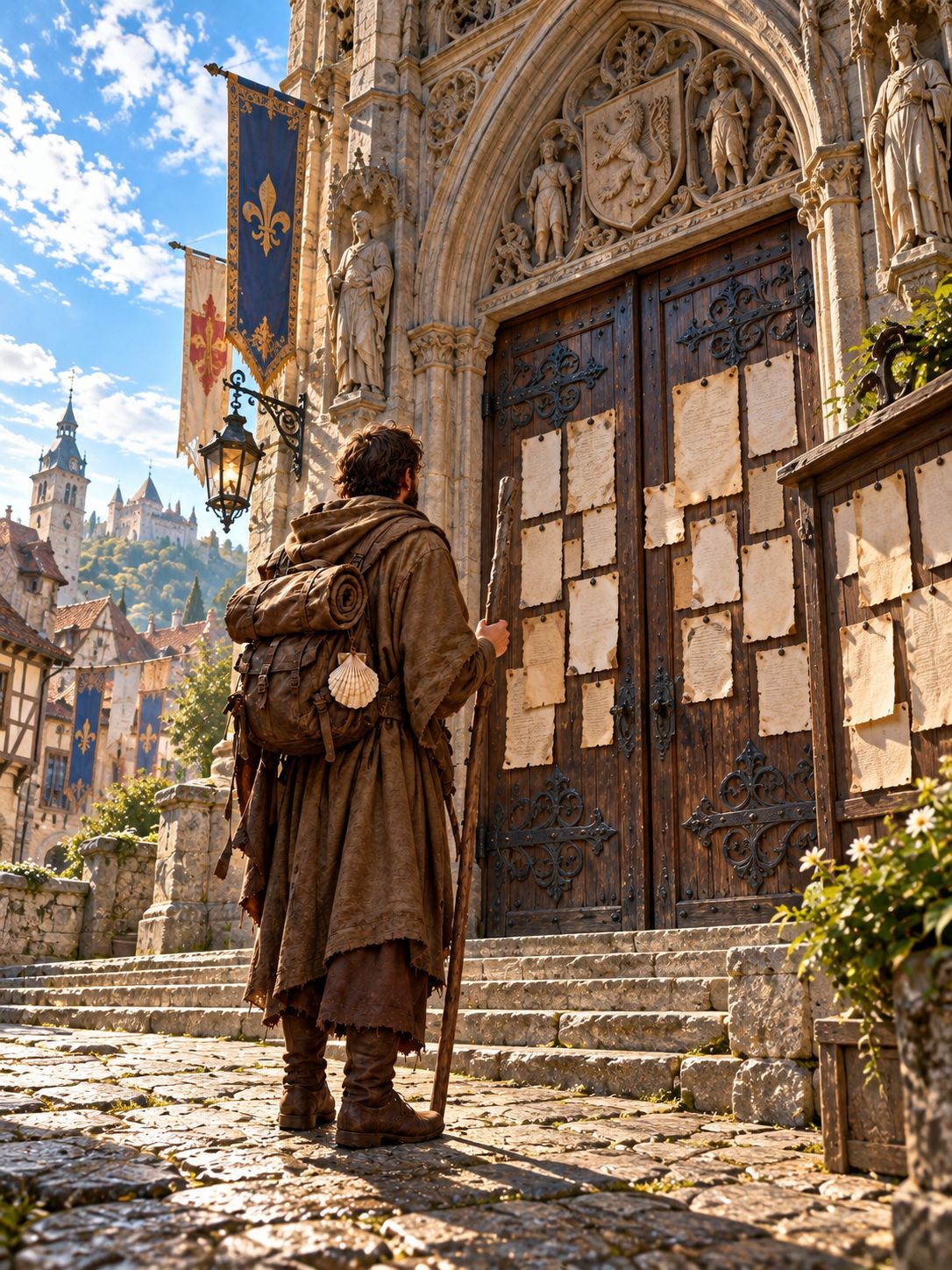
There once was a pilgrim who had been told that it is not enough to have an opinion. One must also stand up for it.
So he went looking for the place where opinions are stood up for. And he found it: a mighty gate of oak, set in carved stone, with coats of arms, statues and banners above it.
Steps leading up to the door.
Lanterns on either side.
And nailed to the wood: notice after notice.
Theses, the pilgrim thought in awe. Demands. Manifestos. Here it is written what one must stand for.

He climbed the steps and read the first notice. It was blank.
So was the second. And the third. All of them. Carefully nailed, neatly aligned, and perfectly blank.
He knocked on the gate. No one opened. Office hours: not stated. Above the door frame, a small black box blinked blue, ready to forward any statement. There were none.
The pilgrim reached for his own pen. Then he put it away again.
And slowly, the pilgrim understood.
Standing up for an opinion does not mean
nailing it to every door.
Some notices say the most when they stay blank.
This is no manifesto. No movement. No representative speaking on your behalf.
It is a gate with blank notices.
Nothing more.
So, Traveler —
Nothing is demanded here.
Nothing is proclaimed.
Nothing is represented.
The gate stays shut.
Go home, pilgrim.
And the notices fluttered softly in the wind.